COFO (Company-Owned, Franchise-Operated) is a hybrid franchise business model where the parent company retains direct ownership of the outlet — property, equipment, and physical assets — while a franchisee runs the day-to-day operations. It balances full corporate control with independent, motivated local management.
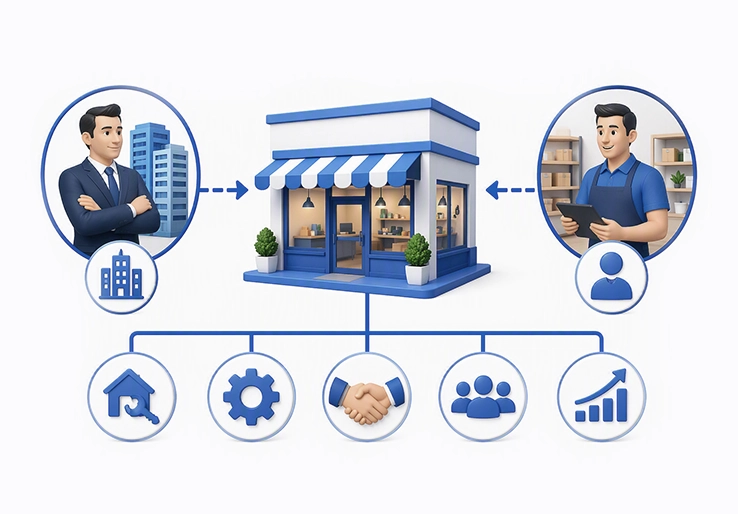
COFO stands for Company Owned Franchise Operated — a hybrid franchise model where the parent company retains direct ownership of the outlet, including property, equipment, and physical assets, while a franchisee runs the day-to-day operations such as staffing, customer service, and local management. This business model sits at the intersection of full corporate control and independent franchise ownership, creating an ideal balance that appeals to both franchisors seeking brand consistency and operators looking to run their own business with lower financial risk.
Explore everything you need to know about the COFO franchise model: its definition and core mechanics, how it compares to other franchise business models ( COCO, FOCO, FOFO), its key benefits and challenges, practical implementation strategies, real-world use cases, and the financial benchmarks that matter. Whether you're a business owner evaluating franchise opportunities, a potential franchisee exploring entry points, or a franchise consultant advising on expansion strategies, this guide provides the depth and clarity required to make informed decisions.
In competitive and emerging markets, COFO allows franchisors to maintain control over brand standards and customer experience while leveraging local expertise for operational excellence. It reduces the capital barrier for franchisees and enables accelerated growth in underserved markets — making it one of the most strategically versatile franchise models available today.
Here's what you'll gain from this article:
The COFO model is a franchise structure in which the company invests in and owns the outlet — covering real estate, infrastructure, branding, fixtures, and initial stock — while the franchisee handles all operational responsibilities. The franchisee runs the store, manages employees, serves customers, and meets performance targets set by the franchisor. In return, the franchisee typically pays royalties or management fees as a percentage of gross revenue, and may contribute to shared marketing funds.
This arrangement is particularly relevant for businesses seeking controlled expansion without shouldering the full burden of managing every location. By retaining ownership of assets, the franchisor enforces brand integrity and consistent brand standards across all locations. Meanwhile, the franchisee brings local market knowledge, operational agility, and entrepreneurial motivation — creating a symbiotic relationship between franchisor and franchisee that drives performance on both sides.
To understand where the COFO model fits, it's essential to compare it against the other primary franchise business models. Each model distributes ownership, operational control, capital investment, and risk differently.
| Criterion | COCO Model | COFO Model | FOCO Model | FOFO Model |
|---|---|---|---|---|
| Asset Ownership | Company owned | Company owned | Franchisee owns | Franchisee owns |
| Operations | Company operated | Franchise operated | Company operated | Franchise operated |
| Capital Investment | Company bears all costs | Company funds assets; franchisee covers operational costs | Franchisee invests in setup; company manages operations | Franchisee bears virtually all costs |
| Operational Control | Full control by company | Franchisee operates under company guidelines | Company has full control | Franchisee has full control |
| Risk Distribution | All risk on company | Asset risk on company; operational risk on franchisee | Financial risk on franchisee; operational risk on company | All risk on franchisee |
| Best For | Flagship stores, new market testing | Brand-critical locations needing local expertise | Passive investors, real estate owners | Maximum scalability with minimal company investment |
Key differentiators come down to three factors: who owns the assets, who manages daily operations, and how investment requirements are distributed. In the COCO model, the company bears both capital and operational costs, giving it full control but maximum exposure. The FOFO model is the opposite — the franchisee owns and operates everything, minimizing company risk but reducing brand control.
The COFO model is preferred over traditional franchise models when the franchisor needs to maintain direct ownership of physical assets for brand control or regulatory compliance, but wants to delegate operational management to motivated local operators. The FOCO model (franchise owned company operated), by contrast, suits passive investors who want to own outlets without managing them.
The COFO business model divides responsibilities into three clear categories:
Company Ownership Responsibilities: The franchisor owns the outlet, including land and initial stock. This covers purchasing or leasing the property, building out the store to brand specifications, installing equipment and signage, establishing supply chain infrastructure, and ensuring the location meets all regulatory requirements. These capital expenditures can be substantial, but they give the franchisor direct ownership of assets to enforce brand integrity.
Franchisee Operational Duties: The franchisee manages daily operations — hiring and training staff, managing payroll and operational expenses, delivering customer service, maintaining inventory, handling local vendor relationships, and meeting sales and quality targets. The franchisee runs the business on the ground, bringing local expertise and entrepreneurial energy.
Shared Responsibilities: Both the franchisee and franchisor collaborate on marketing, brand compliance, and performance standards. The franchisor maintains intellectual property, defines operating manuals, provides training programs, manages broader marketing campaigns, and conducts regular quality audits. Franchise agreements outline responsibilities of franchisor and franchisee, including the agreement specifying operational requirements for brand consistency.
This clear division of roles is precisely what creates mutual value — the company controls the assets and brand, while the franchisee delivers operational excellence at the local level.
The COFO model's appeal lies in its ability to distribute strengths and risks in ways that benefit both parties. Here's how this plays out in practice.
Reduced Operational Burden while Maintaining Asset Control: Because the franchisee handles staffing, management, and service delivery, the franchisor can focus on strategic priorities: product innovation, supply chain optimization, technology infrastructure, and brand management. The company retains direct ownership of outlets, meaning it never loses control over the physical footprint or brand presentation.
Faster Market Expansion with Lower Management Overhead: The COFO model allows for accelerated growth in underserved markets where the company may not have the bandwidth to operate every location. By partnering with qualified operators, franchisors can expand into dozens of locations simultaneously without proportionally growing their corporate management team.
Access to Local Market Expertise through Franchisee Operations: Local operators understand their communities — customer preferences, labor markets, competitive dynamics, and regional regulations. This local expertise translates to better consumer experience and more responsive operations than a distant corporate office could typically deliver.
Maintained Brand Consistency through Ownership Control: Because the franchisor retains ownership of assets, COFO allows full control over brand standards. Store design, equipment quality, signage, and infrastructure remain uniform. The franchisor can quickly replace underperforming franchisees in COFO without the complication of transferring asset ownership — a significant advantage over models where the franchisee owns the outlet.
Lower Initial Capital Requirements: The COFO model reduces risk for franchisees with lower investments compared to traditional franchising (FOFO), where the franchisee invests in real estate, construction, and equipment. In COFO, the franchisee's financial commitment covers operational costs — staffing, utilities, local marketing — rather than heavy capital expenditure.
Operational Autonomy with Company-provided Infrastructure: Franchisees get to run their own business with significant day-to-day decision-making authority, all within a fully equipped, brand-compliant location provided by the franchisor. This is entrepreneurial control without the burden of building from scratch.
Reduced Financial Risk through Shared Investment Model: Since the franchisee doesn't own the real estate or major equipment, they're not exposed to property depreciation, real estate market downturns, or large debt obligations. Franchisees in COFO models face lower initial investment risks, making it an attractive entry point for first-time operators.
Access to Established Brand and Proven Business Systems: Operating under a well established brand means immediate consumer trust, proven operating systems, established supply chains, and operational support from the franchisor — including training, marketing materials, and technology platforms.
The COFO model is ideal for competitive markets requiring rapid expansion where brand control is non-negotiable. It distributes risk effectively: the company bears capital investment risk (asset depreciation, real estate costs), while the franchisee assumes operational risk (staffing challenges, local competition, daily cost management).
This structure also enhances local market penetration. Rather than deploying corporate managers unfamiliar with a region, the franchisor leverages franchisees who already understand the local landscape. The COFO model ensures consistent customer experience across locations while still benefiting from operators who can adapt to local market conditions within the brand's guidelines.
COFO model costs vary by industry and operations scale, but the fundamental economic logic remains constant: the company invests in assets it controls, the franchisee invests effort and operational capital, and both share in the returns.
Moving from understanding COFO's benefits to actually implementing it requires structured planning, clear agreements, and robust operational systems.
Companies should consider COFO implementation when they have the capital to own locations but need local operational capacity, or when expanding into markets where brand consistency is critical. Here's the typical implementation sequence:
The franchisor conducts demographic, competitive, and real estate analysis to identify optimal locations aligned with brand strategy. Since the company owns the property, location quality directly impacts its capital investment.
Beyond financial capacity, the franchisor evaluates managerial track records, cultural alignment, operational competence, and commitment to the franchise concept. Strong franchisee selection is arguably the most critical success factor.
Franchise agreements protect interests of both franchisor and franchisee. The agreement must clearly define asset ownership, revenue sharing (royalties, profit splits), cost responsibilities (rent, utilities, maintenance), operational standards, and performance benchmarks. Franchise agreements include renewal conditions and exit procedures.
The franchisor provides comprehensive training covering brand standards, operating procedures, management information systems, customer service protocols, and compliance requirements. This ensures the franchisee can deliver the expected consumer experience from day one.
Post-launch, the franchisor provides continued operational support including supply chain management, marketing campaigns, technology updates, performance monitoring, and regular compliance audits.
Understanding the financial mechanics of COFO is essential for evaluating its viability. Profit sharing details are outlined in the franchise agreement, and the specifics vary by industry, brand, and geography.
| Financial Element | Company (Franchisor) | Franchisee |
|---|---|---|
| Initial Investment | Real estate, construction, equipment, branding, initial inventory | Security deposits, working capital, training costs |
| Ongoing Costs | Property depreciation, major maintenance, brand marketing | Staffing, utilities, local marketing, operational expenses |
| Revenue | Royalties (% of gross revenue), lease payments, marketing fund contributions | Net profit after operational costs and franchise fees |
| Risk Exposure | Asset depreciation, real estate market, location underperformance | Operational efficiency, staffing quality, local competition |
Globally, franchisee cash-on-cash returns typically fall between 15–35% annually for well-performing units after reaching mature revenues, with typical payback periods of 3–5 years. In India's franchise market — valued at approximately ₹800 billion with expected growth rates of 30–35% annually — the COFO model has proven particularly effective for brands seeking rapid but controlled expansion.
For context, Subway India outlets in metro locations achieve monthly gross revenues of ₹12–18 lakhs. After subtracting cost of goods (~40–45%), rent, staffing, and combined royalty plus advertising fees (~12.5% of gross revenue), net profits for strong locations range from approximately ₹1.5–₹3 lakhs per month, reflecting margins of roughly 6.5–19%. Less favorable locations see margins compress to 1–9%.
COFO model allows for controlled expansion without large franchisee investments, making it viable in markets where aspiring operators have management capability but limited capital for property acquisition.
Day-to-day management in a COFO arrangement requires clear structures:
Reporting and Accountability: The franchisee typically reports to regional managers on sales performance, inventory levels, customer satisfaction scores, and compliance metrics. Modern ERP and POS systems enable real-time data sharing between franchisee and franchisor.
Quality Control and Brand Compliance: Regular audits, mystery shopping programs, standardized operating procedure manuals, and benchmark metrics ensure operational consistency. COFO promotes brand visibility through collaborative marketing efforts coordinated between corporate and local teams.
Performance Evaluation: Franchisors set KPIs covering sales targets, customer satisfaction, employee retention, waste management, and compliance scores. These metrics inform renewal decisions, incentive payments, and — where necessary — franchisee replacement.
Communication Protocols: Structured communication cadences (weekly check-ins, monthly reviews, quarterly business assessments) keep both parties aligned and allow early identification of issues before they escalate.
The COFO model fosters a symbiotic relationship between franchisor and franchisee, but maintaining that relationship requires careful management of several inherent tensions.
Challenge: Managing company oversight while allowing franchisee operational freedom is the central tension in any COFO arrangement. Too much control from the franchisor suppresses the franchisee's entrepreneurial motivation and local responsiveness. Too much autonomy risks brand inconsistency and quality variation.
Solution: Establish clear operational guidelines with well-defined decision-making boundaries. Specify which decisions the franchisee can make independently (staffing schedules, local vendor selection, minor merchandising) versus which require franchisor approval (pricing changes, store modifications, new product introductions). Regular performance reviews — backed by data from CRM management systems — provide objective grounds for evaluation rather than subjective assessments.
Challenge: Disagreements over revenue allocation and cost responsibilities are among the most common sources of friction. If franchise fees consume too large a share of gross revenue, the franchisee may feel squeezed — especially during low-revenue periods or when operational expenses rise unexpectedly. Franchisee-owned units share some expenses with company-owned units, and ambiguity about who pays for what creates conflict.
Solution: Build transparent financial frameworks into the franchise agreement from the outset. Predetermined profit-sharing formulas, clear cost allocation schedules, and formal dispute resolution mechanisms (mediation before arbitration) reduce ambiguity. Publishing benchmarked P&L templates helps franchisees understand expected margins and plan accordingly.
Challenge: Ensuring uniform brand standards across multiple franchisee-operated locations is difficult when each operator brings their own management style and local adaptations. The COFO model ensures consistent customer experience across locations — but only when compliance systems are robust.
Solution: Invest in comprehensive training programs covering every aspect of brand delivery. Conduct regular audits with standardized scoring. Implement mystery shopping programs. Create enforcement protocols with escalation paths: first warning, remediation plan, and clear consequences for persistent non-compliance. The agreement specifying operational requirements for brand consistency should include measurable standards, not vague directives.
Challenge: Maintaining competitive advantage while managing diverse operational approaches across locations requires ongoing attention. Local market conditions change, competitors enter, and consumer preferences shift.
Solution: Continuous market analysis, performance benchmarking against both internal portfolio and industry standards, and adaptive operational strategies keep COFO locations competitive. Franchisors should maintain a warehouse and supply chain infrastructure that gives franchisees cost advantages, and invest in technology that provides real-time performance visibility.
The COFO model has proven effective across multiple industries and geographies. Here are notable real-world applications:
Subway in India extensively uses the COFO approach in metro and growth markets. The franchisor owns or co-invests in outlet infrastructure while franchisees manage daily operations. With combined royalty and advertising fees of approximately 12.5% of gross revenue, the model works when location selection is strong — reinforcing why franchisor-controlled real estate decisions are critical in COFO. Domino's has similarly deployed hybrid models including COFO for strategic locations where brand control is paramount.
Kidzee and EuroKids represent classic COFO implementations. These franchise brands own the school infrastructure and curriculum IP while franchisees operate educational services — managing classroom activities, hiring teachers, and handling local marketing under stringent brand and curriculum guidance. In education, where regulatory compliance and consistent quality directly affect outcomes, franchisor ownership of assets ensures standards are maintained.
Lenskart uses company-owned inventory and retail infrastructure while operating stores through local partners. This approach ensures product quality, pricing consistency, and brand presentation remain uniform across hundreds of locations while benefiting from local operators who understand their customer base. The brick and click business model many retail brands adopt integrates seamlessly with COFO for physical store operations.
Brands like GFresh leverage COFO to enter towns and cities where franchisees lack the capital for full supermarket infrastructure investment but possess strong local management capabilities. The company invests in supply chain, branding, and store buildout; the franchisee runs daily retail operations.
India's franchise market, growing at 30–35% annually, has become a testing ground for COFO adoption. The model works particularly well in markets where aspiring operators have management skills but limited capital — and where franchisors need brand control to protect their investment. Many brands start with COCO units as flagship stores to prove the model, then deploy COFO for expansion into secondary and tertiary markets.
Companies choose COFO over other franchise models when three conditions converge: the brand requires tight control over physical assets, the target market has capable operators with limited capital, and the franchisor has the financial capacity to invest in owned infrastructure.
LOGIC ERP Software is a great fit for businesses using the COFO franchise model because it simplifies managing both company-owned assets and franchisee operations. It gives franchisors clear, real-time insights into sales, inventory, and finances, helping them keep tight control over brand standards and property. At the same time, franchisees get the tools they need to run daily operations smoothly and independently.
The software makes it easy to track compliance with franchise agreements, generate reports automatically, and manage multiple locations without hassle. Its supply chain features help ensure every outlet has the right products at the right time, maintaining consistent quality. Plus, LOGIC ERP's intuitive design and flexible setup make training and onboarding franchisees straightforward.
By using LOGIC ERP, companies can boost efficiency, keep their brand consistent, and make faster, smarter decisions — key ingredients for growing a successful COFO franchise network.
The COFO model — company owned franchise operated — represents a strategic balance between centralized brand control and decentralized operational efficiency. By retaining ownership of assets while empowering local franchisees to manage operations, this franchise model distributes risk, reduces barriers to entry for operators, and enables brands to expand with consistency and speed.
The franchisor maintains brand control while franchisees manage operations — and when this partnership is structured with clear agreements, transparent financials, and robust compliance systems, the results benefit both parties and, ultimately, the customer.
Immediate next steps for organizations considering COFO:
For related exploration, consider diving deeper into franchise agreement templates and legal frameworks, retail franchise models and their variations, operational management systems for multi-location businesses, and performance measurement frameworks for franchise networks.
Call at +91-73411-41176 / +91-73411-41175 or send us an email at sales@logicerp.com to book a free demo today!
In traditional franchising ( FOFO — franchise owned, franchise operated ), the franchisee owns the outlet and operates it, bearing both capital and operational costs. In the COFO model, the company owns the outlet while the franchisee runs the operations. This means the franchisee's initial investment is significantly lower, but they also don't build equity in the physical asset. The franchisor retains ownership of assets to enforce brand integrity and can more easily ensure consistent brand standards across all locations.
Because the franchisor covers real estate, construction, and equipment costs, the franchisee's capital investment is substantially lower than in FOFO models. The franchisee invests primarily in working capital, operational deposits, and training costs. Exact amounts vary widely by industry and operations scale — a quick service restaurant COFO partnership might require a franchisee investment of several lakhs, while a retail or education COFO arrangement may differ significantly.
COFO thrives in industries where brand consistency and asset quality are critical: food service and quick service restaurants, education (preschools, training centers), retail (eyewear, apparel), supermarkets and grocery, and healthcare/wellness. These sectors benefit from franchisor-controlled infrastructure paired with locally managed operations. Industries with very high labor complexity or razor-thin margins may find the model's overhead challenging.
Profit sharing details are outlined in the franchise agreement and vary by brand. Typically, the franchisee pays the franchisor a royalty (percentage of gross revenue, often 5–12%), may contribute to a marketing fund (2–5% of gross), and sometimes pays a lease or rent component. The franchisee retains net profit after subtracting operational costs and these franchise fees. Some agreements also include performance-based incentive structures.
Franchise agreements must clearly define asset ownership, operational responsibilities, cost allocation, profit-sharing formulas, quality standards, audit rights, and termination procedures. Franchise agreements include renewal conditions and exit procedures that protect interests of both franchisor and franchisee. In regulated markets, franchise disclosure requirements (such as the FDD in the United States) mandate detailed financial representations. Legal counsel experienced in franchise law should review all agreements before signing.
Success in COFO requires excellence in four areas: franchisee selection (recruiting operators with proven management capability), contract clarity (transparent agreements with measurable standards), operational systems (technology platforms for real-time monitoring and communication), and ongoing support (continuous training, marketing collaboration, and supply chain advantages). The franchisor can quickly replace underperforming franchisees in COFO — but proactive support reduces the need for such action.
The COFO business model differs from other franchise models like COCO and FOFO by combining company ownership of assets with franchisee management of daily operations. Unlike COCO where the company also operates the outlets, and FOFO where franchisees own and operate, COFO retains asset control with the company while delegating operational responsibility to franchisees.
The COFO model balances company ownership and franchisee operations by having the franchisor own the physical outlet, including property and equipment, while the franchisee runs the day-to-day business activities such as staffing and customer service. This allows the franchisor to maintain brand control while leveraging local expertise.
Key features of the COFO company owned franchise structure include company ownership of real estate and physical assets, franchisee responsibility for operations, shared marketing efforts, clearly defined franchise agreements outlining roles and profit sharing, and a framework that supports brand consistency and operational autonomy.
FOCO and FOFO franchise models differ from COFO mainly in ownership and operational control. FOCO involves franchisees owning the outlet while the company operates it, whereas FOFO has franchisees both owning and operating the outlet. COFO uniquely combines company ownership with franchisee operation.
Operational control in COFO models is held by franchisees who manage daily business functions under company guidelines, while in FOFO models, franchisees have full control over both ownership and operations. COFO allows franchisors to enforce brand standards more directly through asset ownership.
Advantages of a company owned franchise operated (COFO) business model include reduced financial risk for franchisees, maintained brand consistency through company asset ownership, accelerated market expansion with local operational expertise, and the ability for franchisors to quickly replace underperforming franchisees.
The FOCO franchise owned company operated model functions by having franchisees invest capital to own the outlet, while the franchisor manages and operates the business to maintain quality and control. This model suits investors seeking ownership without operational involvement.
Business types best suited for the COFO franchise business model are those requiring strong brand control and asset quality, such as quick service restaurants, education centers, retail chains, supermarkets, and wellness facilities, where franchisors benefit from owning infrastructure but need local operators.
Company owned franchise operated models impact brand consistency positively by allowing franchisors to maintain ownership of physical assets, enforce uniform standards across locations, and coordinate marketing efforts while franchisees focus on operational execution.
Franchisee autonomy in COFO models is balanced; franchisees have significant control over daily operations within franchisor guidelines, whereas in FOFO models, franchisees have full autonomy over both ownership and operations, resulting in greater independence but less direct brand control by the franchisor.
The Franchise Invested Company Operated (FICO) model involves franchisees investing capital to own the franchise unit while the company manages daily operations. This structure allows franchisees to contribute financially without handling the operational responsibilities, which remain with the franchisor.
Unlike the COFO model, where the company owns the outlet and franchisees operate it, and the FOFO model, where franchisees own and operate the outlet, the FICO model features franchisee investment in ownership but company-led operations. This hybrid approach balances financial involvement with centralized operational control.
Running operations in a COFO (Company Owned Franchise Operated) franchise model means that while the parent company owns the physical outlet, property, and assets, the franchisee is responsible for managing the day-to-day business activities. This includes staffing, customer service, local management, and meeting performance targets set by the franchisor. The franchisee operates the business under the company's guidelines, handling operational decisions and local market engagement, while the franchisor maintains control over the brand standards and asset ownership. This arrangement allows the franchisor to ensure brand consistency and asset control, while the franchisee brings local expertise and entrepreneurial management to the operations.
Popular Products